Never Let Me Go
Never Let Me GoNever Let Me Go is the song at the center of one of Kathy H.’s most intimate childhood memories, and its significance changes as she comes to understand what Madame saw when she heard it. To Kathy, the song first becomes a mother’s imagined plea to keep her baby safe; to Madame, the girl dancing with a pillow evokes a vanishing, humane world. Its refrain gathers the novel’s concerns with attachment and separation into a moment that Kathy remembers but cannot fully interpret until much later.
The Song and Kathy’s Private Ritual
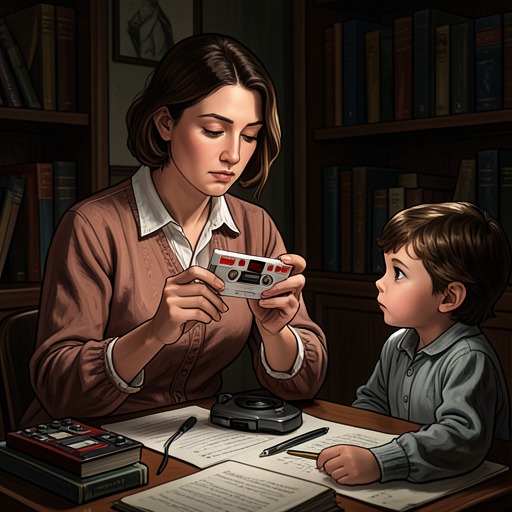
On her Judy Bridgewater cassette, Never Let Me Go is track three. The recording sounds unlike the music favored by the students at Hailsham: Kathy describes it as slow, late-night American cocktail-bar music. She nonetheless treasures this one song, keeping the tape wound to the right place so she can play it whenever she gets an opportunity. The attachment is not to the singer’s style as a whole, but to the recurring refrain, which gives Kathy a private scene to inhabit.
Listening is not easy to arrange. Years before Walkmans begin appearing at Sales, the billiards room and Art Room players are usually surrounded by people. Kathy’s best chance comes in her dorm, in the small six-bed huts, where a portable cassette player sits on a shelf above the radiator. She returns there when the others are unlikely to be present and plays the song over and over. The particular setting matters: the music belongs to a space where she can be alone, and repetition lets her sustain an interpretation that is hers, even though she does not think the lyrics support it.
Kathy imagines a woman who has been told she cannot have children, but then, by a miracle, has a baby she has wanted all her life. The mother holds the child close, singing because she is happy and because she fears the baby may become ill or be taken away. Kathy understands that this is not what the rest of the song means. She does not correct the fantasy, however; the refrain is enough to call it up, and the imagined mother’s fear of separation gives the words their force for her.
Madame Sees the Dance
The private ritual acquires an audience on a sunny afternoon when Kathy goes to the dorm to retrieve something and, on impulse, takes out the cassette. With the player louder than usual, she sways to the music, eyes closed, holding a pillow as though it were the baby in her imagination. She sings softly along when the refrain returns. The pillow makes the scene physically legible to Kathy, but its meaning remains inward: it is a prop for a story she has never explained to anyone.
As the song ends, Kathy opens her eyes and sees Madame framed in the doorway. The dorm door is partly open, as the students are not permitted to close it fully except when sleeping, but Madame has not approached the threshold. She watches from the corridor and is crying. Kathy freezes, then waits for some response—perhaps a reprimand—but Madame turns away and leaves, still sobbing. Kathy sees her hurry toward the main house without looking back. The interruption turns a consoling private performance into an unnerving encounter with an adult whose distress Kathy cannot read.
Kathy tells no one at first. She does not describe herself as exactly ashamed; rather, she wishes the incident had not happened and thinks silence may spare both herself and the others. That response echoes an earlier occasion when the students had gathered around Madame in the courtyard. In both memories, Madame’s discomfort becomes something the children sense but cannot readily question. The song scene thus remains unresolved, carried forward by Kathy rather than explained at the time.
Tommy’s Explanation and Kathy’s Memory
A couple of years later, in the period when Kathy and Tommy have begun asking one another questions about themselves after a conversation by the pond, Kathy tells him what happened. By then, they have been told clearly that they cannot have children. Tommy proposes that Madame saw Kathy holding the imaginary baby and understood the gesture as tragic because Kathy could never become a mother. His explanation connects Madame’s tears to the image Kathy had made, but it does not account for how Madame could have known what the song meant to Kathy or that the pillow stood for a baby.
Kathy raises precisely that difficulty: the association between the song, the imagined mother, and the pillow existed only in her own mind. Tommy half-jokingly suggests that Madame might be able to read minds. The suggestion gives the childhood encounter a mysterious explanation without settling it. For years, the remembered tears and the private fantasy remain joined in Kathy’s account, though the connection between them has not been established.
When Kathy finally asks Madame about the incident, she recounts the scene directly: she had been dancing, Madame had watched and cried, and the pillow had represented a baby in Kathy’s imagination. Madame confirms that she wept, and remembers hearing the music, seeing a little girl alone with her eyes closed, and recognizing the sadness in the song. She also remembers hearing it later on the radio and television and being carried back to the image of the dancing child. The song has therefore continued to function as a point of return for Madame as well as for Kathy, although each remembers the scene through a different understanding.
Madame’s Later Interpretation
Madame rejects the idea that she had read Kathy’s mind. Her tears, she explains, came from what the scene made her see: a rapidly arriving world that was more scientific and efficient, with more cures for old sicknesses, but also harsh and cruel. In the girl holding a baby close, she saw the old, kind world being held as though it could be kept from disappearing. The child’s appeal not to be separated, in Madame’s reading, was not simply Kathy’s private fantasy made visible; it became an image of a world that could not remain.
This explanation does not erase Kathy’s interpretation. Madame’s account gives the dance a second meaning, while preserving the difference between what Kathy meant to enact and what Madame saw. Kathy had imagined a mother afraid of losing a child; Madame recognized a vulnerable figure clinging to a threatened kind of life. The song’s emotional openness allows those meanings to meet without making them identical. Its words do not furnish a factual account of either woman’s thoughts; instead, a refrain and a gesture become the occasion for two different forms of recognition.
Recollection and Significance
The episode gains its force through delayed understanding. As a child, Kathy experiences Madame’s tears as strange and frightening; Tommy later offers an explanation grounded in the students’ inability to have children; Madame, much later, supplies the reason that had remained unavailable to them. Kathy’s recollection holds these interpretations together rather than replacing the earlier ones. The scene’s meaning grows as new knowledge changes how its gestures can be read.
The song also links private attachment to the students’ circumstances without making Kathy’s childhood fantasy a literal prediction. She imagines a child who might be taken away, while the adult world Madame envisions is already passing beyond recovery. In both readings, holding close cannot guarantee that what is loved will stay. Never Let Me Go therefore becomes more than a cherished track on a cassette: it is the refrain through which Kathy’s memory preserves a scene of longing, and through which Madame’s grief becomes intelligible years after it was first witnessed.